


Starlink in Iran: How the regime jams the service and what helps against it
Page 2: Deployment in Iran
Ground stations are necessary to connect the satellite constellation to the internet on Earth, but not every Starlink satellite needs to see one: since satellite version 1.5, the orbiters also have laser links for connections to other satellites on board. According to SpaceX, these operate at up to 200 Gbit/s, while a satellite is supposed to provide up to 100 Gbit/s bandwidth for customers. Data is forwarded via the lasers as in a large mesh network until a satellite in range of a gateway can beam the packets back to Earth. Thus, Starlink can now offer internet access worldwide, and the service works even without a ground station in Iran.
Thousands of user reports from all over the world show that this works well. Starlink actively advertises the service despite lacking frequency usage permits in many places and speaks of "over 150 [covered] countries and territories" in its plan overviews.
However, those who want to use the access must dig very deep into their pockets by Iranian standards, as roaming plans cost around 50 US dollars per month for 100 GByte of data volume and 100 US dollars for unlimited access. In addition, there are significantly higher prices for hardware, as it is smuggled into the country at great risk and must be activated using complex payment transfers: prices between 700 and 2000 US dollars per set are circulating online – a fortune in a country where the average monthly wage is around 200 US dollars.
Therefore, only privileged individuals can afford it, and they take a high personal risk because Starlink use has been punishable in Iran since the end of June 2025: six months to two years in prison, officially. However, in the current situation, one must fear worse.
There are several options for smuggling in Iran's neighborhood: Starlink is already officially operational in Armenia, Azerbaijan, Kazakhstan, Yemen, and Oman.
Easy to Jam
Fundamentally, radio transmissions can be easily jammed with the right equipment. In digital systems, information transfer usually takes place by shifting the phase and amplitude of electromagnetic waves (QAM). Amplitude modulation, i.e., changes in transmission power, can only be evaluated cleanly by the receiver if the signal is strong enough compared to background noise and other interference sources.
If another, stronger transmitter, or one closer to the receiver, overlaps the useful signal (jamming), the receiver can evaluate significantly less of it, or none at all. The effects depend heavily on the bandwidth of the signal being jammed and how the transmitter and receiver handle it. With transmission methods like orthogonal frequency-division multiplexing (OFDM), which uses many narrow-band carriers in succession, more resilient systems can simply exclude jammed areas. This reduces the data rate, but communication with a low error rate remains possible.
If the signal is jammed across its entire bandwidth but not completely overlapped, the transmitter can switch to less complex modulations and, for example, use only phase changes without amplitude jumps for data transmission (Quadrature Phase Shift Keying, QPSK). This also reduces the data transfer rate.
There is no reliable and detailed information on the means by which the Iranian regime is jamming Starlink. However, there are only certain possibilities: The government could try to target satellites specifically from the ground and jam the frequency range between 14.0 and 14.5 GHz with high power. The terminals use this 500 MHz block to transmit to the satellite, which would then have difficulty decoding these signals. However, we consider this method unlikely. The regime would have to deploy a considerable amount of equipment and operate it with high precision continuously, as a Starlink terminal often has more than ten satellites in sight. Since Starlink is designed for rapid changes due to its low orbit, selectively jamming individual satellites would only have a short-term effect.

Electronic warfare systems like the Russian Krasukha-4 are, according to unconfirmed claims, capable of jamming the frequencies used by Starlink. Iran claims to possess similar or identical systems under the name Cobra V8.
(Image: Russian Ministry of Defense)
It is more likely that the security services are jamming the downlink frequencies between 10.7 and 12.7 GHz in certain regions. This is because the protests in larger cities are what’s primarily dangerous for the Iranian government, meaning only in geographically limited areas. Jammers on the roofs of taller buildings could significantly impair the service, because the Starlink signal would be inferior to them at least within a radius of a couple hundred to a few thousand meters around an omnidirectional jammer. Although Starlink terminals point towards the sky, antennas typically also receive and transmit weakly outside their main beam direction – these are known as side lobes in RF engineering. With sufficient power, terminals can therefore also be jammed from the side.
It is likely these side lobes that enable the regime to roughly triangulate and track Starlink users. This involves using large directional antennas to determine the direction from which a signal is coming. If this is done from two or more positions and the directions are combined as lines on a map, one obtains the approximate location of the transmitter.
Position Shift
The regime is almost certainly using one jamming method: GNSS spoofing. This does not interfere with the reception of satellite navigation systems (GNSS, Global Navigation Satellite System) like GPS, Galileo, or GLONASS, but manipulates it. This is critical for Starlink because the terminals rely on knowing their exact position to precisely align their group antennas with the used satellite. The same applies to the satellite, which needs a correct position indication from the terminal to be able to precisely direct its beam at it.
The simplest form of GNSS spoofing: the spoofer receives genuine GNSS packets from orbit and re-emits them with a delay, so that the signal transit time determined by the receiver is incorrect, and thus its calculated position. However, it can also be more sophisticated: complex GNSS spoofers can simulate an entire satellite network for receivers, leading to extreme deviations. The calculated position can then be several hundred kilometers away from the actual position.
The advantage of GNSS spoofing over jamming is that a few watts of transmission power from an elevated position can falsify position determination within a radius of several kilometers; a spoofer on board an aircraft can easily jam entire regions. GNSS satellites are in medium Earth orbit (MEO) at an altitude of about 20,000 kilometers, and their transmission power is tens or a few hundred watts. The signal arriving on earth is extremely weak. Therefore, GNSS receivers are very sensitive and prefer the highest reception levels – thus, if present, a nearby spoofer.
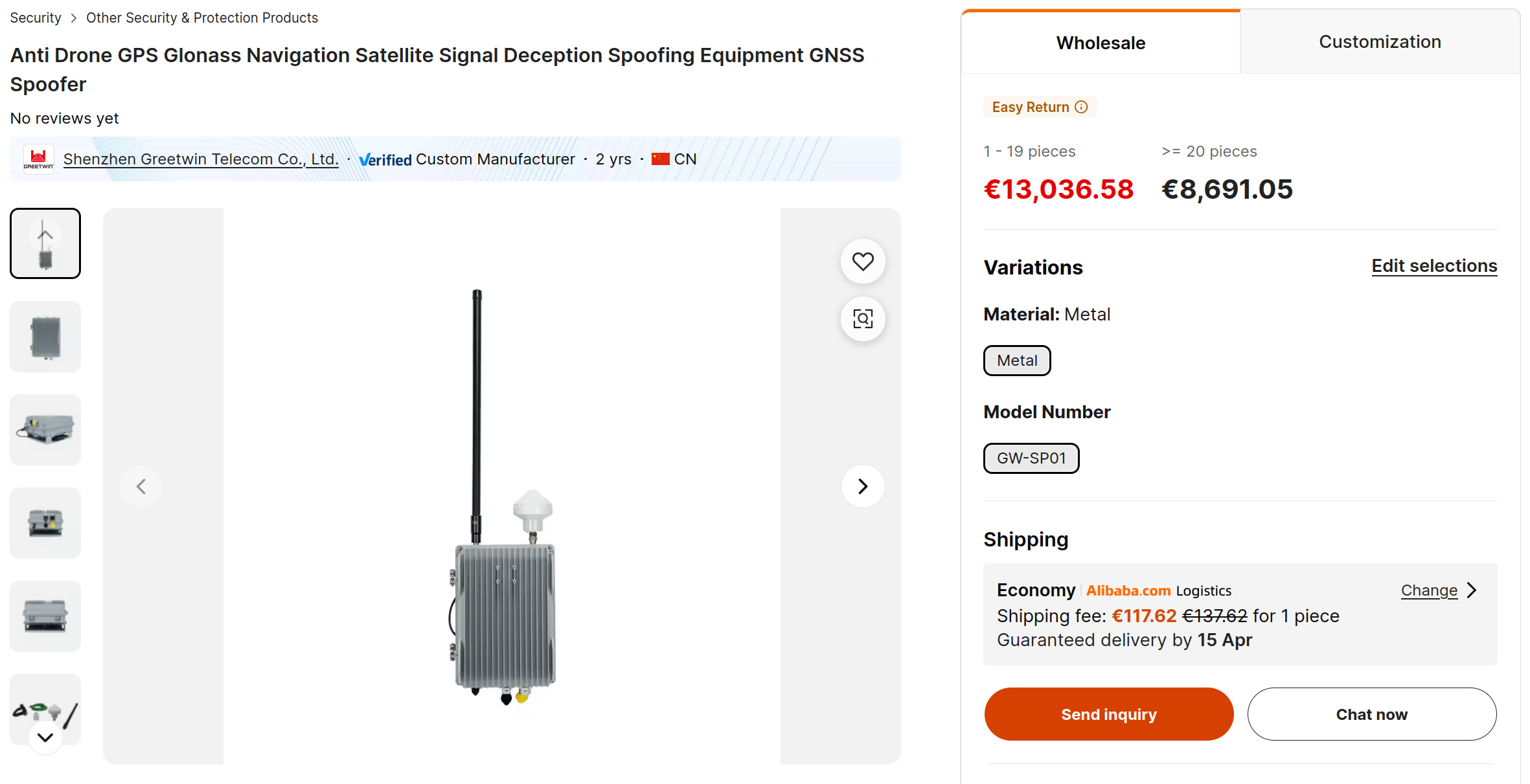
Simple GNSS spoofers, which trick the receiver into believing a false signal transit time by re-emitting genuine satellite signals with a delay, are available for comparatively little money on Chinese wholesale platforms. The operation of such devices is illegal in the European Union.
(Image: heise medien / Alibaba.com)
Today, spoofer hardware can be ordered in larger quantities from China at prices very affordable for governments. Currently, much indicates that Tehran has done so: Iranian opposition activist Nariman Gharib recently published debug data from a Starlink modem in Iran. The data shows indications of GNSS spoofing with delay attacks, but also that Starlink detects these and no longer uses GNSS for position determination. While SpaceX states that Starlink can function without GNSS reception by determining positions from its own signal transit times, the data also shows about 20 percent packet loss on average over 5 minutes, along with a beam direction deviating by 1 degree. This suggests that this function is not yet fully mature in Starlink.
However, the terminal reports normal signal-to-noise ratio in the dataset, which would not be the case with uplink or downlink interference.


