


Suddenly a role model: How Great Britain wants to emulate the German solar boom
The Labour government in London wants to lower energy prices. German recipes are now to help with this - while Berlin is steering in the opposite direction.
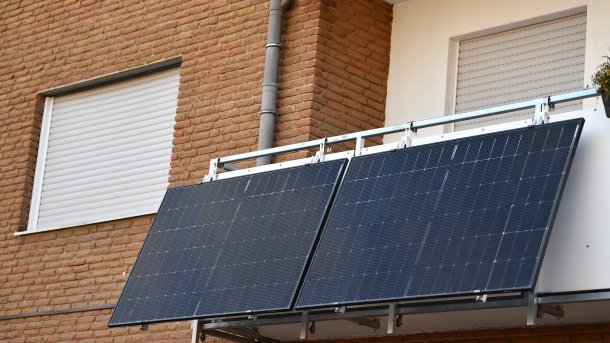
(Image: ChrisStock82 / Shutterstock.com)
When thinking of Scotland, Northern Ireland, Wales, and England, many attributes come to mind, but “sunny” is unlikely to be among them. However, energy costs are also high in the United Kingdom. Now, the Labour government has announced how it intends to support consumers, among other things, with balcony power plants. They are called “plug-in solar panels” there, and they are expected to make a huge difference as early as this summer, according to Energy Minister Ed Miliband – thus helping to curb the energy crisis triggered by the Iran war.
The Iran war has “once again shown that our drive for clean energy is indispensable for our energy security, so that we can free ourselves from the stranglehold of fossil fuel markets that we do not control,” Miliband explained the approach last week.
The United Kingdom shut down its last coal-fired power plant in 2024. Wind and solar already generated a good third of the electrical energy in the second and third quarters of 2025. However, gas came directly after that with 26 percent. The country's 14 nuclear power plants cover only just over a tenth of the electricity demand. For the government, the direction is now clear: renewables, and solar systems in particular, must be expanded. Solar systems and heat pumps are to become standard on new buildings. And all others should be able to buy plug-in solar systems in stores “for energy sovereignty,” according to Miliband.

However, the costs for a simple plug-in solar combination are currently significantly higher in the United Kingdom than, for example, in Germany. Some manufacturers charge over 50 percent more for the same set there.
Plug-in solar still expensive on the islands
Until now, it has been hardly possible to operate a plug-in solar system legally and without problems in the United Kingdom. The reason there too: concerns, for example, about whether the electrical installations would actually cope with an additional 800 watts on a circuit. Until now, balcony power plants had to be disconnected there. “Even if the risk is low: solar PV systems connected to normal household sockets can lead to overheating or impair the function of residual current devices without changes to wiring regulations and under certain circumstances,” warns the Technical Director of Electrical Safety First, for example.
Videos by heise
However, there is no evidence that house installations in the United Kingdom are generally worse than in Germany, for example, outside of historic buildings. The common BS 1363 system there often uses ring circuits – with fuses integrated directly into the plugs or sockets. The “British Standards Institute” (BSI, not to be confused with the German IT security authority of the same name) is now to develop the corresponding guidelines for connecting plug-in solar systems.
But will that be possible before the middle of the year, as aimed for by Keir Starmer's cabinet? Experience with the German process shows that those responsible for standards do not want to take any risks at all.
Lidl and Amazon are to deliver
The government is now hoping for quick initial effects. The government has sought strong allies for this: Lidl UK wants to serve the market with ready-made kits for 400 British pounds. Amazon also wants to deliver as soon as the go-ahead is given. The local branch of energy giant E.ON is also remarkably positive in the United Kingdom: “Removing unnecessary regulation for plug-in solar is an encouraging step, and we will help with the implementation,” quotes its managing director Chris Norbury.
Empfohlener redaktioneller Inhalt
Mit Ihrer Zustimmung wird hier ein externer Preisvergleich (heise Preisvergleich) geladen.
Ich bin damit einverstanden, dass mir externe Inhalte angezeigt werden. Damit können personenbezogene Daten an Drittplattformen (heise Preisvergleich) übermittelt werden. Mehr dazu in unserer Datenschutzerklärung.


(wpl)

