
Savings proposals: Focus first on stable finances, then more digitalization
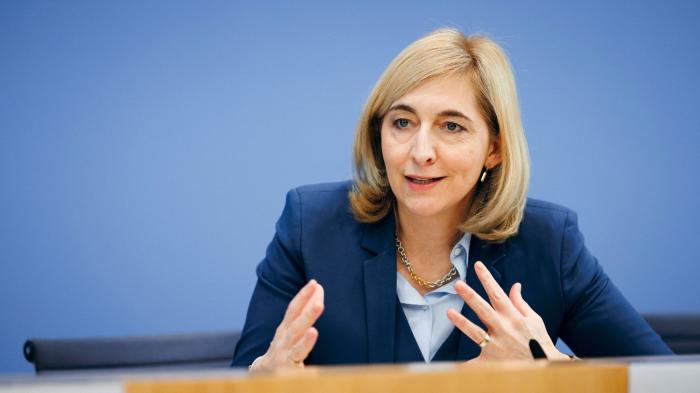
Health Minister Nina Warken at the Federal Press Conference.
(Bild: Xander Heinl / BMG)
The Finance Commission Health also looks at digitalization. It is against ePA remuneration and in favor of stricter rules for "apps on prescription."
The Finance Commission Health recommends a wide range of measures, such as taxes on alcohol, tobacco, and sugar. In its report, the commission also examined the costs of digitizing the healthcare system. According to the report, digital innovations are sometimes generously financed without proven benefits. Health insurers are already making savings through digitalization, but cybersecurity costs are increasing.
With the nationwide introduction of the electronic patient record (elektronische Patientenakte, ePA) for all statutory insured individuals since January 2025, the commission believes the time has come to end the initial funding. Currently, doctor's practices receive separate remuneration for the initial filling and updating of the ePA [1]. The commission recommends abolishing these payments from 2027, saving around 600 million euros annually. The commission justifies this by stating that filling the ePA is largely automatable from a technical standpoint. It is “to be assumed [...] that the efficiency gains will exceed the time required for this.” The legal obligation to use the ePA remains unaffected.
“Clarify the financial situation to citizens”
At the press conference for the presentation of the report, Federal Health Minister Nina Warken signaled that the digitalization of the healthcare system remains a priority for her. “At the same time, we are advancing digitalization. The draft law is currently being coordinated. It's about, for example, how the ePA can be used more quickly, how it can be used with more application cases, how to give the funds more options,” said Warken.
In parallel, “several things are happening that could also improve people's care” and the system, such as laws like the emergency reform. “But of course, one must [...] also make it clear to citizens that, on the one hand, we have the financial situation that we want to stabilize and must stabilize, because without stable finances, the system itself is not stable and future-proof,” said Warken. She intends to present the primary care system in the summer, with the effects only becoming noticeable in 2028.


(Image: FinanzKommission Gesundheit)
Criticism of the costs of digital health applications
The commission also expresses criticism regarding the costs of Digital Health Applications (Digitale Gesundheitsanwendungen, DiGA) [2]. Furthermore, the promised care effects are often not achieved during the trial period, and the dropout rate for DiGA therapies is almost twice as high as for conventional therapies. The commission therefore calls for the abolition of the trial regulation and a benefit assessment similar to that for medicines. In the future, DiGAs will only be reimbursed after a reimbursement amount has been negotiated. Additionally, the commission recommends the introduction of co-payments to promote more responsible use. Overall, the commission warns that digital offerings in healthcare do not deserve special treatment. Processes must be evidence-based, economical, and help patients.
In the area of health insurance administration, the commission notes that digitalization has already brought tangible efficiency gains. “In 2004, an employee on average looked after 487 insured persons; in 2024, it was an average of 563 insured individuals, an increase of 16 percent,” the report states [3]. At the same time, administrative expenses have grown significantly due to increasing demands on cybersecurity and digital infrastructure. “The increasing digitalization is characterized here by stronger process automation and more digital services, but also by higher requirements for cybersecurity and data protection. For example, the larger health insurance funds – from 2024 onwards for 500,000 insured persons, previously from 3 million insured persons – are considered critical infrastructure, for which strict security requirements apply and corresponding investments in IT are necessary,” it states. The commission also sees potential in hospital billing through more consistent use of digital data. In a further report at the end of 2026, the commission intends to present long-term measures.
Furthermore, the commission proposes to limit remuneration regulations from the Terminservice- und Versorgungsgesetz (TSVG) and future fee increases for doctors. The TSVG rules were originally intended to create more incentives for doctor's practices to offer additional appointments, especially for statutory insured people. The National Association of Statutory Health Insurance Physicians (KBV) warns that abolishing the rules without replacement and globally limiting fee increases will lead to “the loss of millions of doctor's appointments.” Practicing physicians will have no choice but to adjust their services and appointment scheduling to the already scarce and in the future further reduced financial resources.
Already today, over 40 million specialist appointments are “on the house,” meaning they are not compensated. However, the KBV expressly welcomes individual recommendations, such as the tax increase on alcohol, tobacco, and sugary drinks, provided that the additional revenue flows entirely into the healthcare system and is not used for budget consolidation.
Ramona Pop, Chairwoman of the Federation of German Consumer Organisations (vzbv), praises, among other things, financing only evidence-based services, but criticizes the austerity plans at the expense of patients: “Higher co-payments, for example for dental prostheses or medicines, create access barriers and weaken equal opportunities in healthcare. People already bear billions in out-of-pocket expenses. Minister Warken has promised to protect the principle of solidarity. Now she must deliver and align the reform with inefficient structures and not with additional burdens for consumers.”
End of the line reached
Oliver Blatt, Chairman of the GKV-Spitzenverband (National Association of Statutory Health Insurance Funds), praises the proposals: “This reform package has the potential to ensure that health insurance contributions remain stable overall in the coming year or can even be lowered [...] Statutory health insurance funds today spend over a billion euros per day on the care of the 75 million citizens insured by statutory health insurance.” This, he says, is the end of the line. “While acknowledging” the proposals for short-term changes, structural reforms are necessary, “which can then take effect from 2028 onwards, are indispensable.”
According to the digital association Bitkom, the proposals of the Finance Commission Health fall short, “as they hardly consider the potential of digitalization.” According to Bitkom, digitalization can “make a crucial contribution to the long-term financial sustainability of our healthcare system.” From Bitkom's perspective, digitalization should be at the center of reform considerations. “Digital solutions such as AI-supported assistance systems, the electronic patient record, or tele-consultations and tele-monitoring can make processes more efficient, relieve healthcare professionals, avoid duplicate examinations and misdiagnoses, and reduce costs,” says Bitkom Managing Director Bernhard Rohleder.

 [4]
[4](mack [5])
Don't miss any news – follow us on Facebook [6], LinkedIn [7] or Mastodon [8].
This article was originally published in German [9]. It was translated with technical assistance and editorially reviewed before publication.
URL dieses Artikels:
https://www.heise.de/-11240636
Links in diesem Artikel:
[1] https://www.heise.de/news/E-Patientenakte-Gemischte-Reaktionen-auf-Befuellungspflicht-fuer-Krankenkassen-9217453.html?from-en=1
[2] https://www.heise.de/news/Krankenkassen-kritisieren-hohe-Kosten-von-Apps-auf-Rezept-und-geringen-Nutzen-10363449.html?from-en=1
[3] https://www.bundesgesundheitsministerium.de/finanzkommission-gesundheit
[4] https://www.heise.de/newsletter/anmeldung.html?id=ki-update&wt_mc=intern.red.ho.ho_nl_ki.ho.markenbanner.markenbanner
[5] mailto:mack@heise.de
[6] https://www.facebook.com/heiseonlineEnglish
[7] https://www.linkedin.com/company/104691972
[8] https://social.heise.de/@heiseonlineenglish
[9] https://www.heise.de/news/Sparvorschlaege-Fokus-zuerst-auf-stabilen-Finanzen-spaeter-mehr-Digitalisierung-11230223.html
Copyright © 2026 Heise Medien