
Pendrive S3: small stick with ESP32-S3 for pentesting and development
(Bild: Thingpulse.com)
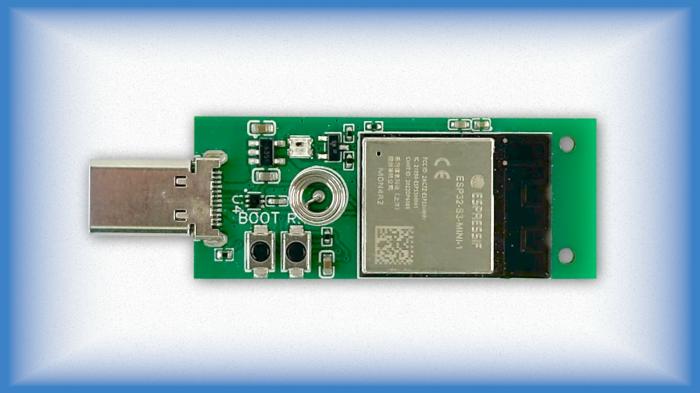
The Pendrive S3 can be used to simulate USB devices of all kinds. From the mouse to the keyboard to the network device or memory stick.
The Pendrive S3 is an ESP32-S3 board with USB-C, WS2812B RGB LED and 128 MB flash memory. With the help of TinyUSB, the ESP32-S3 can present itself as a USB data stick, USB keyboard, USB mouse, audio device, video device or network device, among other things. The kit contains an injection-molded plastic housing and can hardly be distinguished from a normal USB stick on the outside. ThingPulse is a small Swiss hardware and software development company, but production and delivery take place in China.
The WS2812B RGB LED remains visible through the plastic housing. Another interesting technical feature is the der capacitive touch button, which is attached to the housing with a spring [1] and can be operated from the outside without being fed through the housing.

 [2]
[2]The 128 MB flash memory soldered to the underside can be accessed like an SD card and allows the Pendrive to be used like a USB memory stick. However, according to the developers, the speed is "not exhilarating", which is not so important with 128 megabytes.
The Pendrive S3 is also supported by CircuitPython. Soon the Flashen will also work with CircuitPython directly from the website [3].
The Pendrive S3 is available in the Thingpulse store for just under 25 US dollars plus shipping [4]. For our readers, Thingpulse has donated a 5 US dollar discount code ("pendrive-s3-make"). Depending on the value of the order, you will of course have to add duty and tax.


(Image: Thingpulse.com)
Applications
First of all, the Pendrive S3 is simply a development board with ESP32-S3, which can be programmed from Platformio, Arduino IDE and CircuitPython. Furthermore, there are application scenarios that are practically obvious due to the design:
- BadUSB/Rubber Ducky: like Hak5's big but more expensive brother, the Pendrive S3 can simulate various USB devices, such as a keyboard, mouse or network adapter. With den extensions from SuperWiFiDuck [5], keyboard inputs can be automated, the LED controlled and mouse movements programmed. All this via a web interface and with the Ducky scripting language. Scripts can be executed either automatically when plugged in or when the capacitive button is touched.
- WiFi dongle: the Pendrive S3 can also be configured as a WiFi network adapter [6].
- WiFi Disk: thanks to the flash chip, the Pendrive S3 can be mounted on the computer like a 128 MByte stick, but can also share its content via the web interface or automatically synchronize with an FTP server.
(caw [8])
Don't miss any news – follow us on Facebook [9], LinkedIn [10] or Mastodon [11].
This article was originally published in German [12]. It was translated with technical assistance and editorially reviewed before publication.
URL dieses Artikels:
https://www.heise.de/-9755948
Links in diesem Artikel:
[1] https://thingpulse.com/overcoming-design-challenges-the-touch-button-solution-for-the-pendrive-s3/
[2] https://www.heise.de/newsletter/anmeldung.html?id=ki-update&wt_mc=intern.red.ho.ho_nl_ki.ho.markenbanner.markenbanner
[3] https://circuitpython.org/board/ThingPulse_PendriveS3/
[4] https://thingpulse.com/product/esp32-s3-pendrive-s3-128mb/
[5] https://github.com/squix78/SuperWiFiDuck
[6] https://thingpulse.com/spicy-prototypes-esp32-s3-pendrive/
[7] https://shop.heise.de/make-esp32-cam-special-2023-board-ov2640?wt_mc=intern.shop.shop.make_esp32cam.dos.textlink.textlink
[8] mailto:caw@make-magazin.de
[9] https://www.facebook.com/heiseonlineEnglish
[10] https://www.linkedin.com/company/104691972
[11] https://social.heise.de/@heiseonlineenglish
[12] https://www.heise.de/news/Pendrive-S3-kleiner-Stick-mit-ESP32-S3-fuer-Pentesting-und-Entwicklung-9755786.html
Copyright © 2024 Heise Medien