

ICCT forecast: share of electric cars will have to increase
In a study, the ICCT assumes that the proportion of e-cars will rise sharply in order to comply with the fleet limit value. Anything else would be expensive.

The range of electric cars in the A, B and C segments will increase, because only here can buyer groups be activated that are large enough in number to have an effect on fleet emissions. Citroën, for example, has presented the ë-C3 Aircross, which is available from 26,490 euros.
(Image: Citroën)
- Christoph M. Schwarzer
By 2025, 28 percent of new registrations must be electric cars. This is the forecast of the International Council on Clean Transportation (ICCT) in a study. However, as the ICCT emphasizes, this figure is the result of an extreme scenario. For example, there is unlikely to be any progress in CO₂ emissions for cars with combustion engines – an assumption that is not very realistic. The 28 percent mentioned therefore marks a theoretical upper end. This is also what the ICCT says, in whose analysis one thing is particularly striking: how many legal ways there are for the car industry to avoid possible fines from the European Union.
Formally, manufacturers have to pay 95 euros per vehicle sold in the EU and per gram exceeding the specific limit value. This will be tightened by 15 percent in 2025. This could easily add up to several million euros. Nevertheless, it is neither foreseeable nor likely that a manufacturer will have to transfer money to Brussels.
(Image: ICCT)
RED III supplements test bench emissions
The mechanism of the CO₂ fleet limit value: each newly registered car in the European Economic Area (EEA), i.e. the 27 EU member states plus Iceland, Liechtenstein and Norway, but excluding the UK, is assigned an individual CO₂ value. This is determined on the laboratory test bench according to the WLTP (Worldwide harmonized Light vehicle Test Procedure) and measured at the exhaust: For electric cars, this basically means zero grams of carbon dioxide. The criticism that emissions would be shifted to electricity generation is only partially correct: the European Union also regulates the fuel side via the Renewable Energy Directive (RED), the third version of which (RED III) stipulates, among other things, that 42.5 percent of total energy consumption in 2030 must come from renewable sources.
Twelve percent reduction required compared to 2023
In the period from 2021 to 2024, the average CO₂ value of a manufacturer must not exceed 95 grams per kilometer – in the outdated New European Driving Cycle (NEDC). It is important to note that these 95 grams are an average value across all manufacturers. The individual limit value of a car manufacturer may be lower or higher, depending on the average unladen weight.
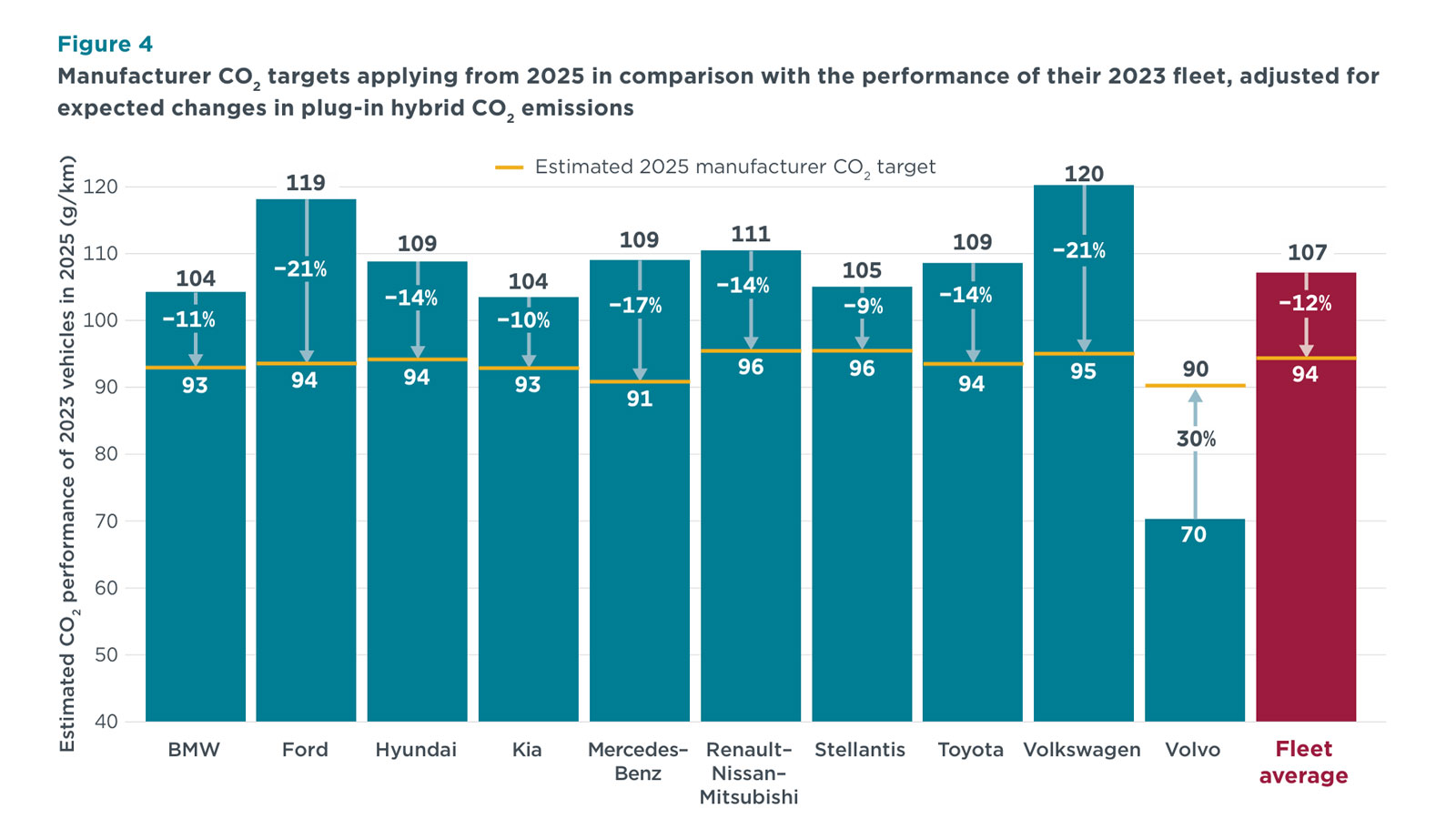
After conversion to WLTP and taking this weight factor into account, the Volkswagen Group, for example, has an actual provisional target value of 121 g CO₂/km for the current year. For Mercedes, the figure is 131 g CO₂/km due to the fat fleet, and 114 g CO₂/km for the lighter Toyotas. The ICCT uses the fully balanced year 2023 as the basis for its calculations. At 107 g CO₂/km, the average actually achieved by the car industry was already below the legally required level. Based on this value, the reduction to the 2025 target value of 94 g CO₂/km is no longer 15, but only twelve percent.
Reverse effect of the weight factor
The reverse effect of the weight factor in 2025 is interesting: nothing has changed in the formula. However, the large number of passenger cars with high mass and no CO₂ emissions –, i.e. electric cars –, means that a manufacturer with particularly heavy passenger cars on average will have stricter rather than more lenient CO₂ limits in the coming period from 2025 to 2029. Specifically, Mercedes, for example, will have to reduce from 138 to 91 g CO₂/km, while Toyota will only have to reduce from 114 to 94 g CO₂/km. What looks like a high hurdle for Mercedes is put into perspective against the backdrop of the value of 109 g CO₂/km achieved in 2023.
ZLEV correction factor
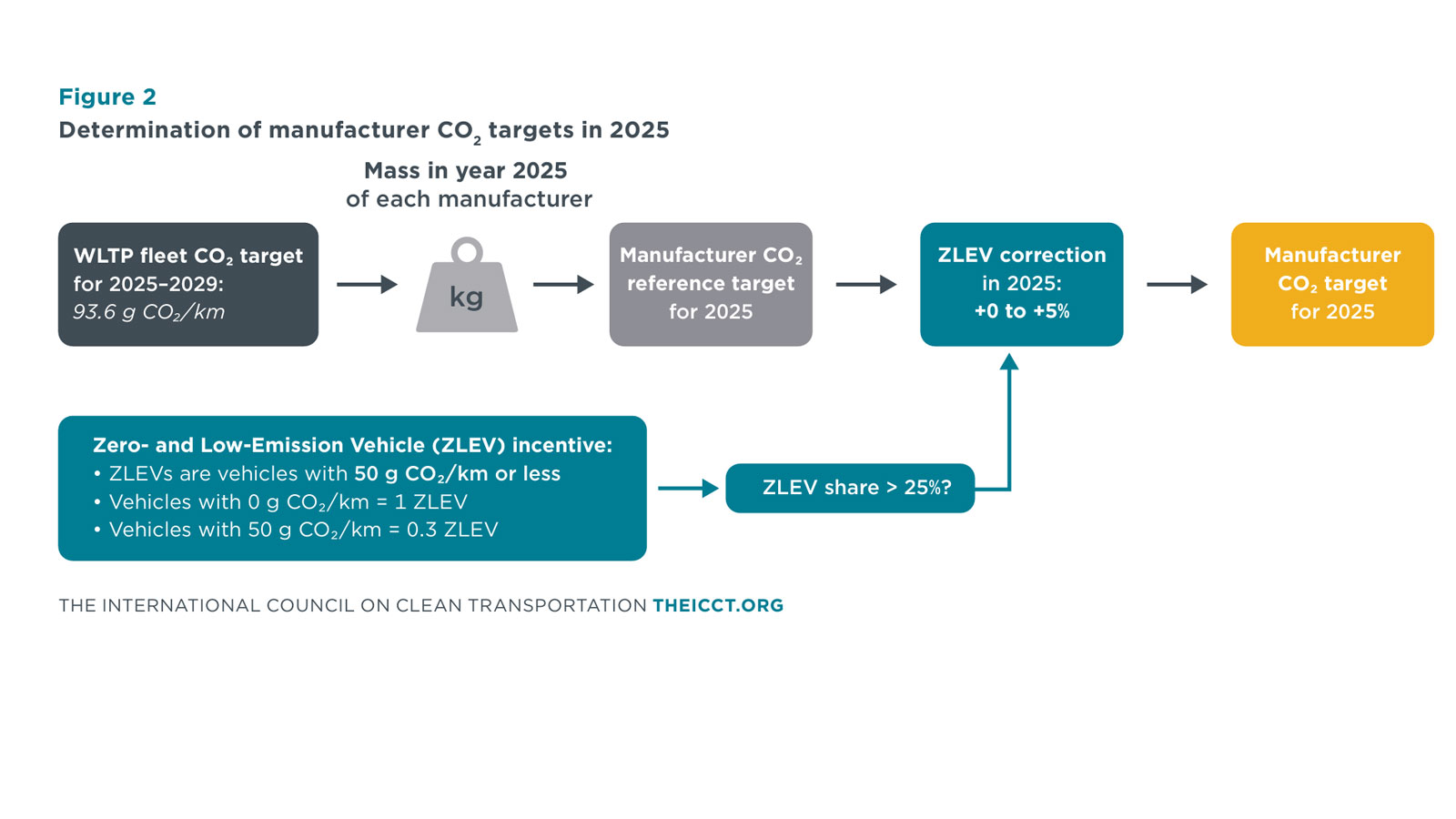
The ICCT's list of reductions and scope for balancing is extensive. Although the recalculation of the weight factor leads to a considerable reduction in the limit value for 2025, the ZLEV correction factor (for Zero and Low Emission Vehicle) counteracts this. This refers to electric cars and plug-in hybrids. The correction factor means that a manufacturer can offset the percentage of ZLEV that is above 25 percent against the fleet limit.
(Image: ICCT)
It works like this: if a company registers 27 percent of new electric cars, for example, the difference to 25 percent – i.e. two percent – is added to the limit value as a discount. So if a manufacturer is allowed to have a maximum of 100 g CO₂/km in 2025, the ZLEV correction factor would turn this into 102 g CO₂/km. This added value is limited by law to a maximum of five percent.
The decline of plug-in hybrids
Plug-in hybrids are worth less: they are only credited with a factor of 0.3. So if, for example, a manufacturer allows 17 percent electric cars and 20 percent PHEVs, the latter would only count as six percent. The sum of 17 plus 6 = 23 percent would in turn be lower than 25 percent, so there would be no advantage.
(Image: ICCT)
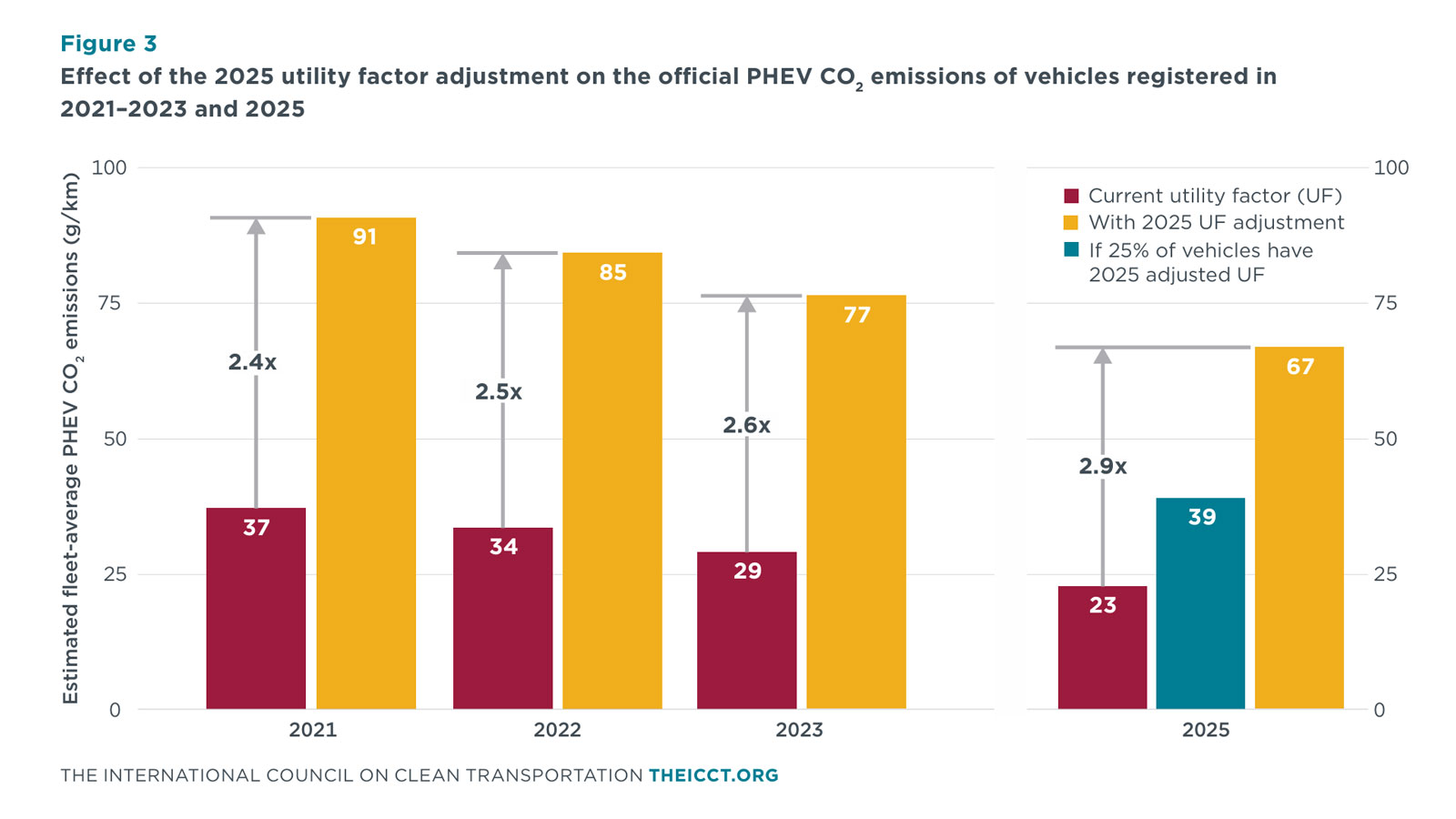
PHEVs also lose importance in the CO₂ fleet mechanism due to the so-called utility factor (UF). Put simply, the formal CO₂ value increases even if the electric range increases. Two adjustments to the UF are planned, which will probably lead to a devaluation of plug-in hybrids for the CO₂ limits by 2030. Because it will gradually become cheaper for the car industry to produce electric cars, PHEVs will be a marginal phenomenon by the end of the decade, as things stand today.

Pooling is allowed
Pooling is an option that is rarely used by the automotive industry to improve its own CO₂ fleet values: each manufacturer can share a balance sheet with everyone else. The ICCT turns this into a puzzle to see who might be interested: Volkswagen and Tesla, for example, or Ford and Volvo. These mental options are more mathematical models than real possibilities for action, because Tesla and Volvo would pay to sell the zero emissions of their own electric cars. On a smaller scale, however, there have been mergers in the past, such as Toyota with Mazda, Subaru and Suzuki.
As mentioned, the 28 percent of electric cars calculated by the ICCT would be the result of an extreme scenario. A particularly simple tool for improving CO₂ values and having to sell fewer electric cars is, for example, changing the CO₂ values of cars with combustion engines. Here, the ICCT assumes that there will be no reduction. However, manufacturers can already achieve a reduction by removing certain engine variants or producing more low-CO₂ versions. It is equally unlikely that the importance of PHEVs will immediately drop sharply in 2025. Volkswagen, for example, is going on the offensive once again at the end of this drive type. The long-range e-hybrids will have a slightly reducing effect before the first stage of the UF tightening takes effect in model year 2026.
Videos by heise
More choice for electric cars in the A, B and C segments
The ICCT is not only aware of all this, it is also stated in principle in the analysis. Nevertheless, the ICCT does not commit itself to an exact share of electric cars in a plausible rather than an extreme scenario and prefers to describe a from-to spectrum.
(Image: ICCT)
If we take a current forecast from Schmidt Automotive Research, which assumes a good 22 percent of electric cars, and calculate the average, we can assume a market share of around a quarter. That is also much more than the 16 to 17 percent today. For customers, this means a greater choice of electric cars in any case, especially in the segment between 20,000 and 40,000 euros. In this way, buyer groups can be activated that are large enough to comply with the CO₂ fleet limits.
(mho)