


Missing link: How New York is failing to digitize public transport tickets
With the OMNY NFC system, New York's public transport operator MTA wanted to make everything better. It turned out differently – also because of data protection
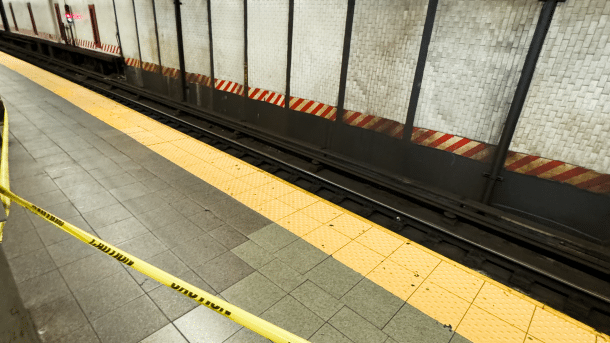
Subway platform in New York City.
(Image: heise online / Ben Schwan)
New York City has a fantastic public transportation system by American standards. There is a subway with almost 400 km of track, three commuter railroads that connect the city and surrounding areas, a short subway system for commuters from New Jersey called PATH, numerous buses plus streetcar systems in the surrounding areas. However, the system is only somewhat comprehensible to city dwellers – and even they are surprised every day.
Although the MTA operates the subway, two of the three commuter rail lines and many buses, there is not even a standardized fare or ticket system for them, let alone a real transport network. If you want to get from JFK Airport to Manhattan in comfort, for example, you first use the AirTrain operated by PATH (which at least supports MetroCards, the old MTA ticket system) and then change to the Long Island Rail Road (LIRR), which in turn uses its own tickets (including its own app and conductor).
The MTA also knows that such a system eats up resources in the long term and is difficult to explain to tourists and newcomers to the city. It therefore began digitizing its ticketing system in 2019. The solution to all the problems was to be called OMNY, an abbreviation for "One Metro New York". The first step was to replace the old ticket system with MetroCards, which still have a magnetic strip and once replaced the world-famous "tokens" of the New York Subway. Five years after the launch of the OMNY system, disillusionment is setting in. On the one hand, it seems as if some goals have been achieved. But the truth is that everything is even more confused than before.
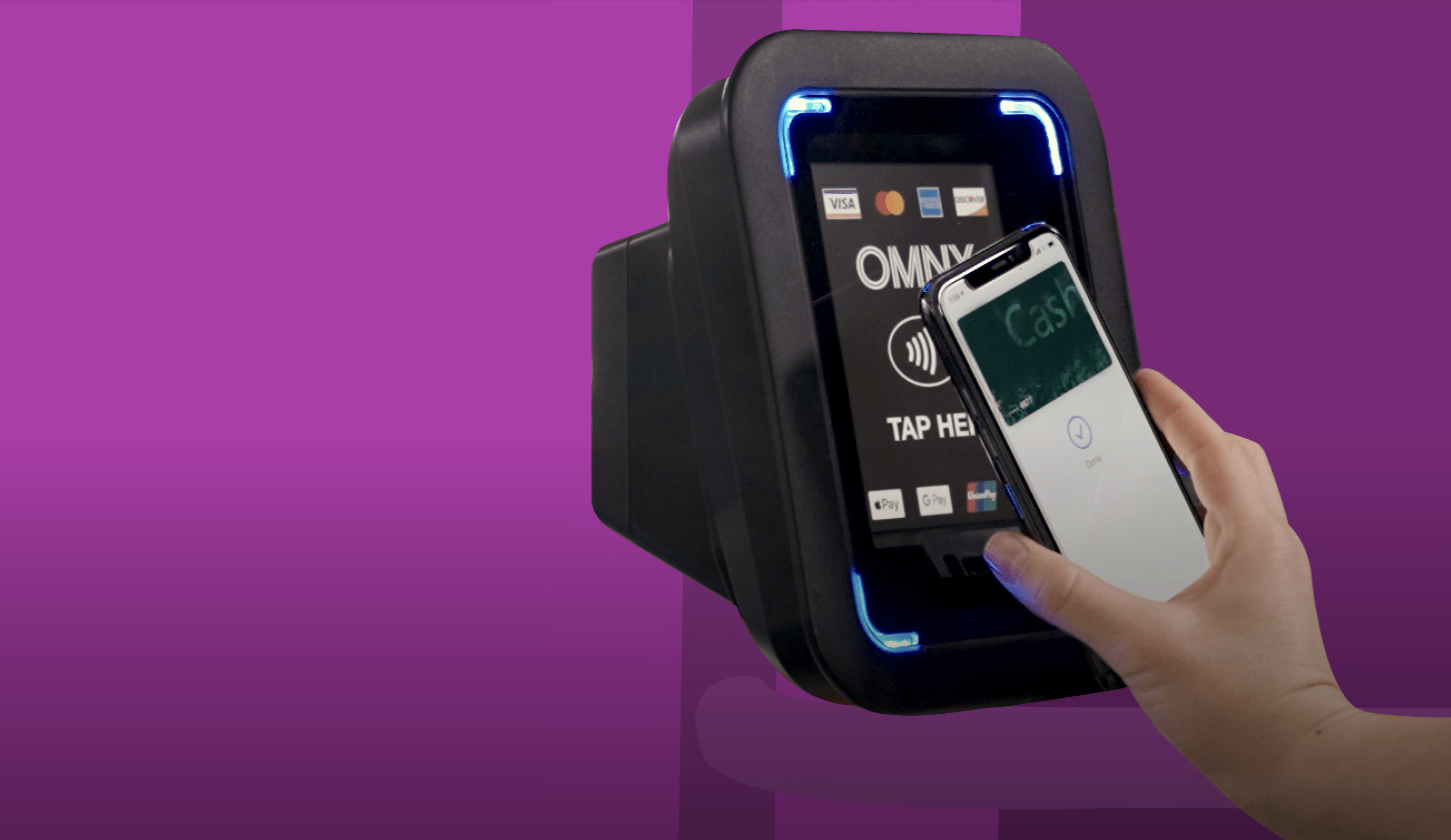
(Image: OMNY / MTA)
Magnetic strips still in use, plus additional app
A reader for MetroCard magnetic strips is still installed at every subway, AirTrain and PATH station and on every bus. OMNY is just an additional system that hardly anyone understands. In addition, both the LIRR and Metro-North, the MTA's commuter railroads, still do not accept OMNY. This is because they have their own app, called TrainTime, which the MTA claims is very popular with users.
So there are currently three ways to ride the subway or AirTrain in New York:
1. you buy a MetroCard from a machine as usual (they are available at every station and at kiosks) and then charge it, riding until it is empty. A standard fare of 2.90 US dollars applies in the Subway, which is charged when you enter the system, no matter how far you travel.
2. you use an NFC credit card, Google Pay, Apple Pay or Samsung Pay (plus alternative systems) with a credit card on file to check in - something we know from London, for example. The fee is then debited directly from the card. When changing to the bus, make sure you always use the same payment method.
3. buy a physical OMNY card with NFC instead of the MetroCard. This can also be topped up, even online. Advantage: It is more robust due to the lack of a magnetic strip and is not susceptible to unwanted erasure by means of a magnetic field. The problem: OMNY tickets are available at comparatively few stations or kiosks, as the MTA cannot keep up with setting up the machines.
However, if you want to travel with LIRR or Metro-North, you need the TrainTime app mentioned above. This has a completely separate account system including support for Apple Pay and Google Pay, uses a QR code instead of NFC (which the conductor then checks by eye) and is also used to understand the complicated fare system with distance and peak and off-peak prices. Result: Every day, it often happens that newcomers to the city or tourists try to travel with MetroCard LIRR or Metro-North.
To make the confusion complete, the PATH short subway has meanwhile started to roll out its own payment system called TAPP, which in the longer term will only work with contactless credit cards. MetroCard and a proprietary smart card system called SmartLink are set to go the way of the dodo on the rapid transit system to Newark and Hoboken.
Security gaps, rebudgeting and two service providers
Why OMNY (almost) failed
Now you could say that OMNY has not failed at all, as the system is still in use. However, it is currently running on crutches. Originally, LIRR and Metro-North were also supposed to receive the new system in order to finally create a standardized system for MTA services. But that didn't work out. An app for OMNY has been promised for five years, but has turned out to be a joke. You need the website to manage your OMNY card (which requires you to enter an 18-digit card number plus a security code).
What's more, it is not possible to view your charging history or the journeys you have already made (trip history). This makes it impossible for people who have to submit a travel expense report to use the system - unless they use individual prepaid top-ups for which an invoice is sent by e-mail. When using Contactless with a credit card - which is supposed to be so convenient - it also becomes a drama as you can't track what you've actually paid for. You have to write down every journey and then check whether something has been charged incorrectly. Complaints can only be made by phone or via the AI chat assistant - although the latter is, as expected, not very helpful.
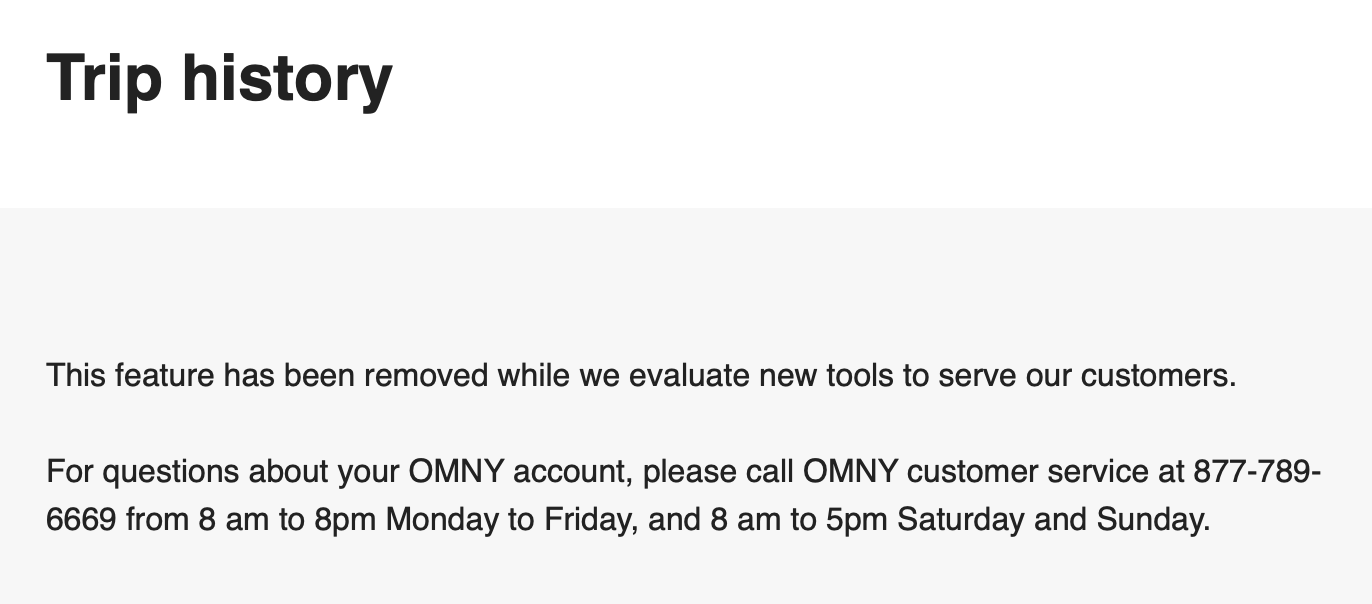
(Image: Screenshot OMNY-Website)
The reason for the lack of charging history, including trip history, is that journalists discovered a year ago that it was comparatively easy to read other users' data. It was enough to know the person's credit card number to retrieve information on where people had traveled. "The point of the feature was to help our customers who wanted to check their tap-and-go trip history, whether paid or free, without having to create an OMNY account," the MTA said.
After publication, the transport authority reacted promptly and simply switched off the functions in the same month. As befits a transportation authority that is notorious among old New Yorkers for being bureaucratic, there has been no further development since then: the website still simply states that it is "reviewing" "new tools for our customers". Strangely enough, even people with an OMNY account can no longer access their travel data, although this is not a problem in terms of data protection.
One app as hope, while another app never comes
It is unclear what will happen with OMNY. According to media reports, the MTA was planning to switch to the aforementioned TrainTime app, which is used by LIRR and Metro-North. Only the MTA knows exactly how this will work, as TrainTime works with QR codes as mentioned and not with NFC like OMNY. It is possible that the app will then be expanded accordingly, as we know it from other world cities such as Paris, where the wallet integrated in the smartphone with NFC function then becomes a ticket. As mentioned, the MTA had actually promised to implement a smartphone app for OMNY, but this never happened- even half a decade after its launch. "It's the Duke Nukem of public transit apps," someone joked on Reddit.
In May, the MTA then announced "upcoming OMNY milestones for 2024". Reduced OMNY cards for senior citizens would soon be released, as well as OMNY tickets for schoolchildren for the first time. There will also be new ticket machines at LIRR and Metro North stations. However, these are not planned for OMNY; instead, the TrainTime system will continue to be used. To make matters worse, TrainTime and OMNY use two different service providers. Cubic, the company behind OMNY, wurden recently withdrew orders because it is hoped that the TrainTime provider Masabi could be faster here.
MTA boss Janno Lieber said the new approach would finally give passengers the "sense of interoperability they expect". Unfortunately, feelings are not facts. And so public transport users in America's largest metropolis will continue to interact with a ticketing system that has still not been fully digitized. No one is currently giving a timetable for the completion of the project. After all, it is a "megaproject", as the MTA writes.


(bsc)


