


20 years of "God of War": Greek battle platter
It's exactly 20 years since Kratos first slashed his way through a 'God of War' adventure. And what a debut that was!

(Image: Sony)
Most modern games take their time: calm main menu, relaxed tutorial, leisurely starting challenges. Not so "God of War": Hero Kratos looks at you from the main menu as if you had personally strangled his mother, and one press of "New Game" later follows an even today impressive pan directly into the game, which opens with the words "The Gods of Olympus have abandoned me. Now there is no hope."
A flashback then takes us directly to the first boss fight, or to be precise, the first boss level. Because the entire first section in the Aegean is just the backdrop for the epic battle against the Hydra, which ends with one of the giant beast's heads being impaled on a sailing mast while the other two explode in blood. And that was just the first level.
"God of War", which was in development at Sony's Santa Monica studio for around three years under the direction of David "Twisted Metal" Jaffe and was released exclusively on the Playstation 2 at the end of March 2005, is fundamentally based on Greek mythology. Anyone who has ever seen a Sandals movie or two will be familiar with names such as Zeus, Athena or Aphrodite, fantasy creatures such as Hydra and Minotaur or the basic concept of Pandora's Box. However, you should not start the game with the expectation of receiving an interactive history lesson: Although the developers have drawn on ancient writings, they spin their own story from them. Which mainly revolves around revenge.
Knee-deep in blood
Kratos is not exactly a glittering figure of sympathy: a tall, muscle-bound Spartan with ashen skin streaked with red tattoos. His standard stance is that of an aggressive beast, bent forward, legs wide, arms broad, with the "chaos blades" welded to the flesh at each end: Mementos of his pact with the god of war Ares, who once saved him from certain death on the battlefield, making Kratos his compliant slave for all time.
"God of War" wird 20 (12 Bilder)
heise online
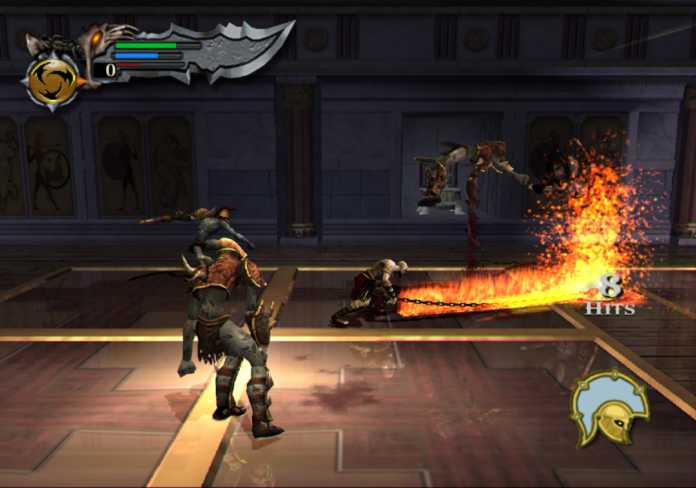
)There's a clever plot twist about halfway through the game that explains who Kratos is, what he has against the gods and where his striking appearance comes from. In any case, his declared mission is to destroy Ares – and on the way to this goal, which is actually unattainable for a normal mortal, he walks over every corpse: Whether it's soldier zombies, harpies, cyclops, sirens, hellhounds or occasional bosses such as a gigantic mecha-minotaur – they all fall victim sooner or later to the constant hammering of the chaos blades or the oversized sword of Artemis.
Alternatively, Kratos can also use magic in the course of the game to throw lightning bolts around, have the undead army of the underworld god Hades fight for him or turn his enemies to stone via the severed head of Medusa. These spells require the use of mana and, just like Kratos' weapons, they can be strengthened several times over the course of the adventure. However, this requires corresponding upgrade points, which either wait to be discovered in crates or leave the bodies of destroyed enemies in elegant arcs.
Videos by heise
Destruction in close-up
Destruction is a good keyword, because "God of War" has never been a game of false modesty. Every confrontation quickly degenerates into a fierce slaughter; heads roll, arms fly, Kratos can grab his opponents, throw them and literally tear them apart in the air. The more enemies you slaughter in succession, the higher your combo counter climbs and the more upgrade points you earn.
The unusual thing about "God of War", even back then, was the uncompromising brutality on screen. Of course, there have always been games in which things were more violent: In 2000's "Soldier of Fortune", for example, you were allowed to smash your polygon enemies into bloody chunks with well-aimed shots; in 1992's "Mortal Kombat", spinal columns were plucked from enemy bodies. You don't have to think it's great, but it was simply part of video game escapism.
"God of War" took this slaughtering platter to the next level by celebrating the destruction of enemy mythical creatures: In any other game, for example, you would bash a minotaur with your weapon until its health bar is empty, it falls over, you move on. In "God of War", on the other hand, the knocked-down energy bar signified the start of a "Quick Time Event", a button-pushing mini-game: if you hammered quickly on the briefly displayed Playstation button symbols, an animation was played in which Kratos slowly but inexorably pushed a chaos blade down the throat of the desperately resisting minotaur. Even 20 years on, that's still intense.
Greek escapism
And it was almost too violent for Germany, as the game was released a year late. The reason for this was that Sony Computer Entertainment Europe only released a content-adapted version in Germany. The most important change in this version can be found in the Temple of Pandora, in which Kratos sacrifices a Greek soldier to the gods in a fire trap in the original version –, a rather unpleasant scene, as the soldier begs bitterly for his life the whole time. In the version released in this country, it was turned into a dehumanized zombie that just hisses the whole time.
However, "God of War" is not just about fighting, the action is repeatedly interrupted by tests of skill and puzzles. Especially in the second half of the game, which mainly takes place in the gigantic Temple of Pandora, Kratos not only has to flex his Spartan muscles, but also use his Spartan brain: There are statues and crates to be pushed onto pressure plates, levers to be flipped and massive blocks of stone to be turned via ancient machines so that they can be pushed into one another.

Of course, not all puzzles are winners, especially when timers are involved: There are deadly spikes driving out of the ground after a certain time while you try to reach an important necklace. Or dismantle a collection of enemies as quickly as possible before the ground breaks out from under your feet. And then Pandora's Palace consists of several rings inside, which you have to constantly and very tediously move around to reach new rooms and thus further challenges. Back then, people swallowed this pill because there was hardly a comparable mixture of action and puzzles. But from today's point of view, these sections seem rather tedious.
Speaking of "tedious": Kratos later visits the Greek underworld several times. And only the gods know what the developers had in mind for these sections! The staging is cool, everything is blood-red and fiery, the souls of the dead race past you left and right. But then Kratos has to balance again and again and again and again over rotating rollers or climb them on his way to freedom, while constantly being injured and pushed down by rotating blades. Baaah, terrible!
What a game!
As a consolation, "God of War" offered one of the best audiovisual experiences of its time. It's important to remember that the Playstation 2 was in its sixth year of life at the time and the successor console was already waiting in the wings. But what Sony's developers were still able to get out of the aged hardware suggests dark magic: Animations, graphic effects, camera movements, the sheer size and attention to detail of the buildings and landscapes – that was nothing less than spectacular back then!
Nowadays, of course, the graphics standards are completely different, but even today it is very impressive to climb around the outside of the Temple of Pandora. At the same time, you get a glimpse of the titan Kronos crawling on the ground far, far away. Admiring the beautiful statues, the magnificent floor reflections in the palaces or the detailed underwater realms of the god Neptune.
It's amazing how well the first "God of War" still works today. Of course, the series has evolved in terms of content and technology over the years and has taken an interesting new direction since the 2018 reboot of the same name. And yet, even 20 years later, it is still a wonderfully primitive pleasure to slash and slash your way through the hordes of Greek mythical creatures with the OG Kratos. This is accompanied by one of the most monumental game soundtracks of all time.
It was simply the best possible farewell gift to a departing console.


(mack)

